Blog · · Tuckmade team
How to read a tuck box dieline: cut, crease, perforation and glue marks
What each line on a tuck box dieline means: cut lines, crease lines, perforations and glue areas, plus how to find the front panel and L x W x D.
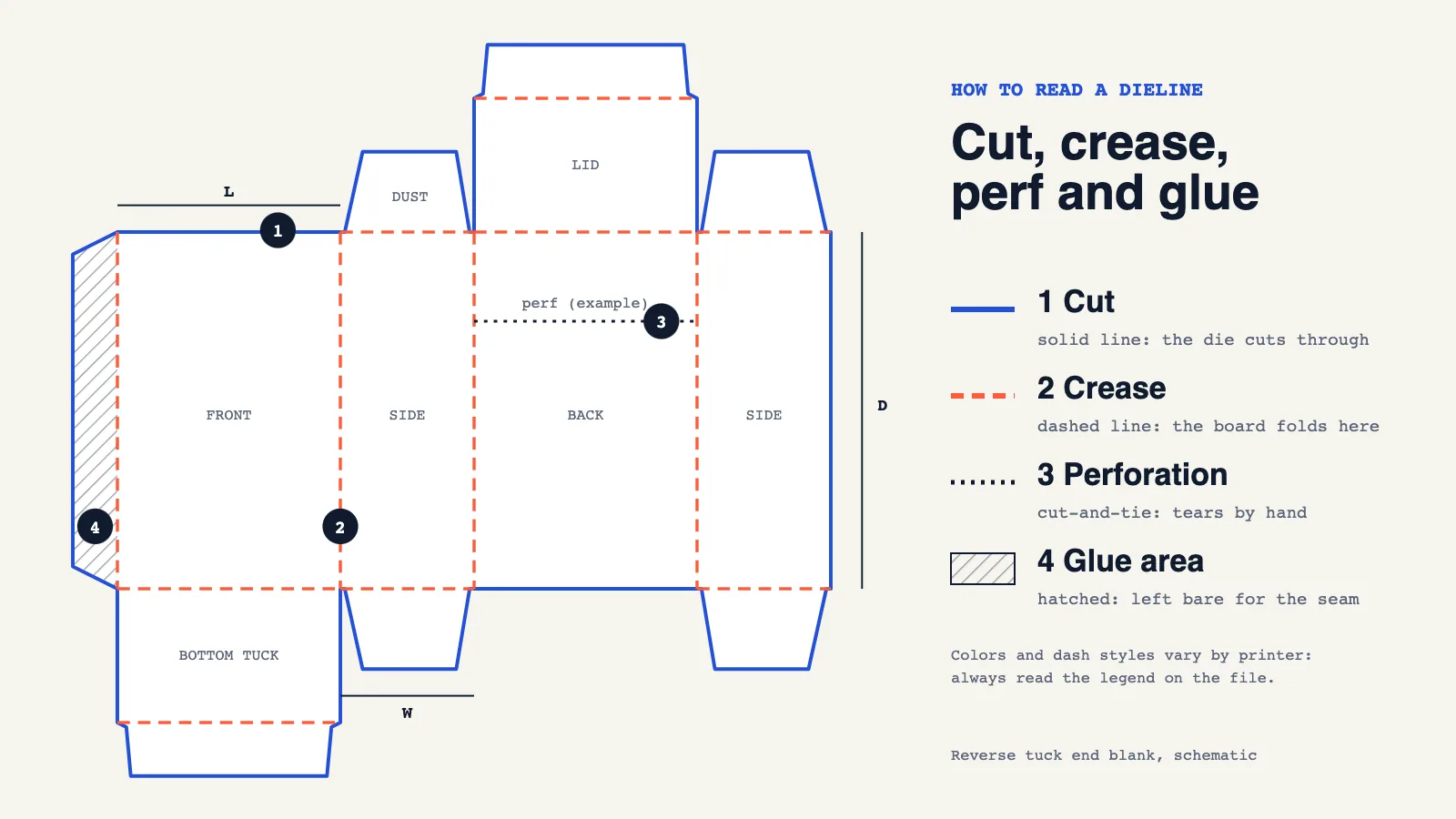
To read a tuck box dieline, start with the legend. Solid lines are usually cuts, where the die goes through the board. Dashed lines are creases, where the board folds. Dotted or short-dash lines are perforations that tear by hand, and hatched areas are glue zones left unprinted. Then find the front panel and the L x W x D labels.
Line colors and dash styles are not standardized across printers, and a misread line is how a logo ends up across a fold. Here is each mark on a real tuck box layout.
What is a dieline, and what does it show?
A dieline is the flat outline of a carton before it is folded and glued. Folding cartons are printed, cut, folded and glued, then shipped flat. The dieline shows where the die will cut the board, where it will press a crease, and which areas are reserved for glue.
On a tuck box the dieline is usually one connected shape: four body panels in a row (front, side, back, side), a narrow glue flap at one end, a lid with a tuck flap, a bottom closure, and small dust flaps beside the lid and bottom. Different styles change the closures. A reverse tuck end box has its lid on the back panel and its bottom tuck on the front panel; a straight tuck end box has both tucks on the same panel; a snap lock bottom replaces the bottom tuck with four interlocking flaps.
What do solid lines mean on a dieline?
Solid lines are cut lines on most dielines. They mark the outer edge of the blank and any shapes cut out of it, such as a hang hole, a thumb notch or a window opening. Everything outside the solid outline is waste board that is stripped away after die cutting.
Two things to check on cut lines:
- Bleed. Background color and images that touch a cut edge should run past it, because die cutting has a small tolerance. Our rule of thumb is 1/8 in. One folding box printer asks for at least 2 mm beyond the die-cutting contour. Our artwork setup guide covers this in detail.
- Internal cuts. A window or hang hole is also a cut line. Keep text away from it.
In production files the cut line usually sits on its own layer or spot color, set to overprint, so it never prints on the box. The folding box printer above names its contour layer and asks for it in a solid spot color set to overprint. Do not delete or move that layer; place your artwork underneath it.
What do dashed lines mean on a dieline?
Dashed lines are usually creases (also called fold or score lines). The die does not cut through the board here; a creasing rule presses a channel into it so it folds cleanly in one place. Steel rule dies typically combine cutting and creasing rules, so cuts and creases are made in one pass.
This is where the biggest variation between suppliers shows up. One US packaging supplier's guide, for example, draws fold lines as solid red lines and saves dotted or dashed lines for perforations. Tuckmade's planning dielines draw cuts as solid blue and folds as dashed coral. Neither is wrong, but it means you cannot assume a dashed line is a fold on every file. Read the legend, or ask.
What creases mean for your artwork:
- Text and logos should stay off creases. A line of type that crosses a fold cracks or wraps onto the next panel. Keep important content about 1/8 in from every crease as well as every cut.
- Panels are defined by creases. The space between two vertical creases is a panel: front, side, back or side. Count them to find which is which.
What does a perforation line look like?
A perforation is a line of short cuts with small uncut bridges (ties) between them, so the board holds together until someone tears it. On a dieline it is usually drawn as a dotted line or a short-dash pattern that differs from the crease pattern, and is often labeled "perf".
On tuck boxes, perforations show up on:
- Display lids. A tuck display box can have a lid that tears away along a perforation to turn the carton into a counter tray.
- Tear strips and tamper features that show a box has been opened.
Treat a perforation like a cut line for artwork: no text, barcodes or fine detail across it.
What do hatched areas mean?
Hatched (striped or criss-crossed) areas are usually glue zones. On a tuck box the main one is the glue flap that bonds to the inside of the opposite panel to form the side seam. One supplier's guide shows glue tabs as green criss-cross areas; the folding box printer above uses striped areas and states that gluing areas are not printed. Leave them bare in your file so the glue bonds to the board, not to ink or coating. That printer also asks for adjacent artwork to overlap the glue flap by 3 mm, and for a 2 mm safety distance between important elements and the glue line.
How do you find the front panel and the box size?
Once the lines make sense, orient yourself before placing artwork:
| Mark | What to look for |
|---|---|
| L (length) | Width of the front and back panels, left to right |
| W (width) | Width of the two side panels |
| D (depth) | Height of the body panels, from top crease to bottom crease |
| Front panel | Usually labeled; on a reverse tuck end it carries the bottom tuck |
| Lid | The flap that hinges from a body panel and ends in the tuck flap |
| Grain or print direction | Sometimes shown as an arrow; follow it if present |
Tuckmade sizes are inside dimensions (the space your product goes into). Other files may use outside dimensions, so check which one the dieline states before you compare sizes. The size guide explains how to measure a product for a tuck box.
Then print the dieline at 100 percent with your artwork on it, cut, fold and close it. Panel order and text on a fold become obvious in a minute.
Where do you get a dieline for your box?
For planning, the dielines page has free SVG and PDF dielines for common tuck styles and sizes, drawn at true size with solid blue cuts and dashed coral folds. They are simplified: flap shapes and clearances are generic.
For production, use the dieline drawn for your exact size and board. With Tuckmade, every order gets a free digital design and dieline, and a digital proof of your artwork on that dieline before anything prints. If you have a size in mind, start with the quote form.
FAQ
Are dieline colors standard?
No. Most suppliers draw cut lines as solid lines, but colors and dash styles for creases, perforations, bleed and safe areas vary. One supplier draws folds as solid red lines; Tuckmade draws them as dashed coral. Always read the legend on the file you were given.
What is the difference between a crease and a perforation?
A crease is pressed into the board so it folds without cutting through. A perforation is a row of short cuts with small ties between them, so the board stays together until it is torn by hand. Keep artwork details off both.
Should the dieline print on my box?
No. The dieline sits on its own layer or spot color, set to overprint, and is used only to make the cutting die. Keep it on a separate layer in your file and do not merge it into the artwork.
Can I print on the hatched glue area?
Leave it unprinted. Glue bonds best to bare board, and ink or coating there can weaken the seam. A small overlap of background color from the adjacent panel is normal.
Sources
- PakFactory, "What is a Dieline in Packaging & Print?" (21 Feb 2023; cut, fold, bleed, safety, perforation and glue tab line styles), read 1 Nov 2026: https://pakfactory.com/blog/what-is-a-dieline/
- labelprint24, "Artwork requirements for folding boxes" (contour layer in a solid color set to overprint, 2 mm bleed, gluing areas not printed, 3 mm overfill, 2 mm from the glue line), read 1 Nov 2026: https://www.labelprint24.com/en/data-check/artwork-requirements-for-folding-boxes-71
- Wikipedia, "Die cutting (web)" (steel-rule tools combine cutting and creasing rules in one pass; perforations and creases), read 1 Nov 2026: https://en.wikipedia.org/wiki/Die_cutting_(web)
- Wikipedia, "Folding carton" (printed, laminated, cut, then folded and glued; shipped flat), read 1 Nov 2026: https://en.wikipedia.org/wiki/Folding_carton