Blog · · Tuckmade team
Auto bottom vs snap lock bottom: which base carries more weight?
Auto (crash lock) bottom vs snap lock (1-2-3) bottom on a tuck top box: how each base locks, which holds heavier products, and how to choose.
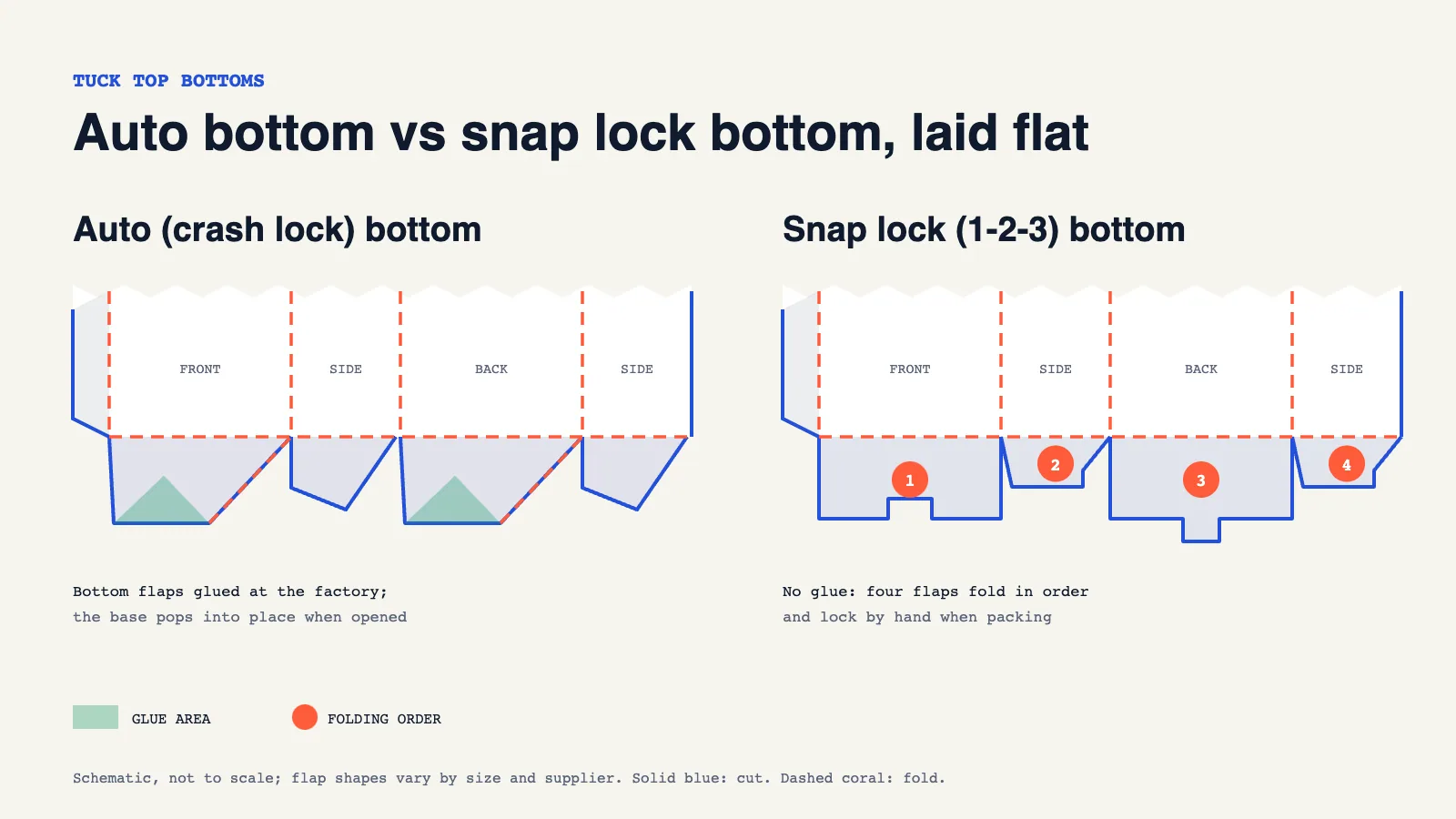
As a rule of thumb, an auto bottom carries more weight. Its bottom flaps are glued at the factory, so the base pops open as one locked piece. A snap lock bottom has no glue: four flaps interlock by hand, which holds medium-weight products well but depends on how carefully each box is folded.
What is the difference between an auto bottom and a snap lock bottom?
Both are bottoms for a tuck top box: the top closes with an ordinary tuck flap, and only the base changes. The difference is where the base gets its strength.
- Auto bottom (also called crash lock or automatic bottom). The bottom flaps are folded and glued while the carton is made. You receive the box flat; when you open it, the base drops into place and locks.
- Snap lock bottom (also called a 1-2-3 bottom or lock bottom). The bottom flaps are die cut with notches and tabs but not glued. When you pack, you fold them in order and they lock into each other.
A patent on cardboard waste containers gives a plain definition of the first: an automatic bottom is a box "with a preglued bottom, where it is necessary only to press the cardboard ... box out into its erected state, and where the bottom is then ready formed." One supplier's option sheet describes the second as "four flaps featuring a tab to fold together and create a secure lock without using adhesive."
How does an auto bottom work?
Folding cartons usually leave the factory as a flat tube. Wikipedia's carton article notes that folding cartons "are usually combined into a tube at the manufacturer and shipped flat (knocked down) to the packager." A tuck end carton is glued only along its side seam. An auto bottom carton adds a second gluing step: the bottom flaps are folded over and glued to each other inside the same flat tube.
A patent on folder-gluer machines describes this in production terms. On standard boxes, "the transverse tabs are folded outside the folder-gluer." On crash-lock bottom boxes, the front tabs are folded inside the machine as well. That extra folding and gluing is what lets the base set itself up later.
What it means for you:
- Fast packing. Squaring the box forms the base. There is no folding order to learn.
- Consistent bases. Every box is glued the same way at the factory, so the base does not depend on who packed it.
- A more complex blank. The flaps are larger, with diagonal folds, and they need a gluing machine set up for crash lock work. That is why an auto bottom is usually quoted per job.
How does a snap lock bottom work?
A snap lock base is all die cutting and no glue. Each of the four bottom flaps has a shape that fits the others: a notch on one, a tab on another, a cut-out where they meet. The packer folds the flaps in a set order, and the last flap tucks under or into the others so the base holds itself shut. The "1-2-3" name comes from that sequence.
What it means for you:
- Simpler to make. The carton is glued only on its side seam, like a tuck end box.
- Stronger than a tuck bottom, as a rule of thumb. Four interlocking flaps give the base more support than a single tuck flap with two dust flaps.
- Slower to pack, and packer-dependent. Each box takes a few extra folds, and a base folded out of order or not pressed flat will hold less.
Which bottom carries more weight?
No neutral body publishes a load rating for either base. The real limit depends on the board, the box size, how the weight sits and how the box is carried, so treat the following as a rule of thumb rather than a measured number:
| Auto (crash lock) bottom | Snap lock (1-2-3) bottom | Tuck bottom | |
|---|---|---|---|
| How the base forms | Pops open; flaps already glued | Four flaps folded in order by hand | Dust flaps plus one tuck flap |
| Glue in the base | Yes, at the factory | No | No |
| Packing speed | Fastest | Slower | Slow |
| Typical products | Jars, bottles, electronics, heavier retail items | Candles, mugs, hardware, glass bottles | Light items such as cosmetics and tea |
| Main risk | Higher set-up cost per job | A base folded wrongly or loosely | Base pushing open under weight |
The auto bottom usually wins because its strength comes from glue as well as the fold. A snap lock base relies only on the flaps' shape, the stiffness of the board and how well it was folded.
For weight, board matters as much as the base. A heavy glass candle in a thin folding carton can still sag. For heavier products, the board thickness guide explains when to move from a single-ply board such as SBS C1S to white E-flute.
When should you choose an auto bottom?
Choose a tuck top auto bottom box when:
- the product is heavy for the box, such as a glass jar, a bottle or a boxed device;
- you pack by hand at volume and speed matters;
- many different people pack your boxes and you want every base the same;
- the box is lifted from the top, so the base takes the full weight.
Our tuck end vs auto lock bottom guide compares the auto bottom with a plain tuck end in more detail.
When is a snap lock bottom enough?
Choose a tuck top snap lock bottom box when:
- the product is medium weight, such as a candle, a mug or a pack of hardware;
- you pack small batches yourself and a few extra folds are no trouble;
- you want a base stronger than a tuck bottom without paying for a glued one.
How do you test a bottom before ordering?
Ask for the dieline at your size and print it at full size on card stock, or ask for a digital proof to check the flap layout. Then fold a test box, put the real product in, and lift it by the top a few times. Tip it on its side and set it down hard. If the base bows or a flap slips, move to the stronger base or a thicker board.
The tuck box dieline generator draws an auto bottom style at your size for planning. For production, every order comes with a free digital design and dieline drawn for your product and board, and a digital proof before anything prints. There is no minimum order quantity: order 1 piece or 10,000. Tell us the product weight on the quote form.
FAQ
Is an auto bottom the same as a crash lock bottom?
Yes. Auto bottom, auto lock bottom, crash lock bottom and automatic bottom are names for the same idea: a base whose flaps are glued during manufacture so it forms itself when the flat box is opened.
Is a snap lock bottom the same as a 1-2-3 bottom?
In most supplier catalogs, yes. Both names describe a glue-free base where four flaps fold in a set order and lock together. Names vary, so check the dieline drawing rather than the name alone.
Which is cheaper, auto bottom or snap lock bottom?
A snap lock bottom is usually simpler to make because the base needs no gluing. An auto bottom adds a folding and gluing step at the factory, so it is typically priced per job. You save that time again at packing.
Can a snap lock bottom hold a glass candle?
Often, yes, when the box fits snugly and the board is stiff enough. For large or heavy candles, or boxes carried by the top, an auto bottom or a thicker board is the safer choice. Test with the real product first.
Sources
- Wikipedia, "Carton" (folding cartons are usually combined into a tube at the manufacturer and shipped flat), read 4 Nov 2026: https://en.wikipedia.org/wiki/Carton
- Google Patents, US20160101934A1 "Waste container" (definition of an automatic bottom: a preglued bottom pressed out into its erected state), read 4 Nov 2026: https://patents.google.com/patent/US20160101934A1/en
- Google Patents, US8647248B2 "Device for conveying and folding blanks" (crash-lock bottom boxes have their front tabs folded inside the folder-gluer; standard boxes do not), read 4 Nov 2026: https://patents.google.com/patent/US8647248B2/en
- PakFactory, "Snap Lock" (OP072) and "Auto Bottom" (OP073) option pages (four flaps that lock without adhesive; pre-glued panels for easy assembly), read 4 Nov 2026: https://pakfactory.com/style-detail-snap-lock.html