Blog · · Tuckmade team
Dust flaps on tuck boxes: what they do and when to skip them
What dust flaps on a tuck box do, the plain, locking and bellow types, and which tuck styles close without them at one end.
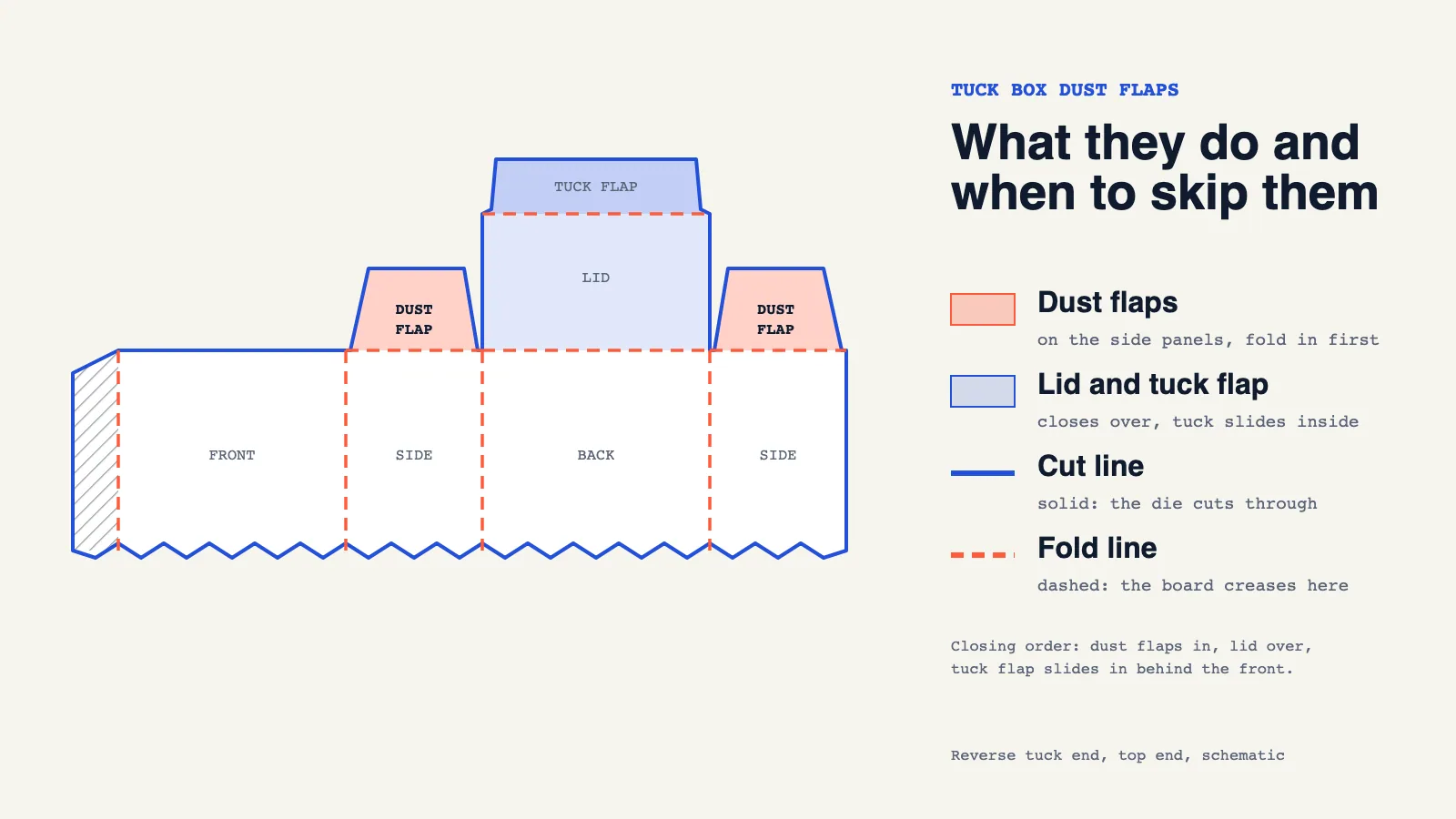
Dust flaps are the small flaps on the two side panels at each tuck end. They fold in first, before the lid, to close the corner gaps, keep dust out, square up the carton and give the tuck flap something to press against. Every tuck end keeps them; an auto bottom or snap lock base replaces them at that end.
What are dust flaps on a tuck box?
A tuck box closes with a lid that hinges from one body panel and ends in a tuck flap, the curved strip that slides inside the box. On the two side panels next to that lid sit two smaller flaps, one each side. Those are the dust flaps.
On a flat reverse tuck end blank they appear at both ends, beside the lid and beside the bottom closure. A straight tuck end has the same flaps; only the lid positions change.
One packaging maker describes the standard option simply: "Flaps are added to block dust from entering the packaging with tuck top and seal end design." That is where the name comes from.
What do dust flaps actually do?
Dust flaps do four small jobs at once:
- Close the corners. Without them, the lid would cover the opening but leave gaps at the two short sides. The dust flaps fill that space under the lid.
- Square the end. Folded in, they brace the side panels so the end of the box sits square instead of pinching inward.
- Hold the tuck. The tuck flap slides down between the dust flaps and the panel opposite the lid's hinge. The friction against the dust flaps and the panel is part of what keeps a plain tuck lid from springing open.
Our how a tuck box folds guide walks through the full fold sequence with both ends.
What types of dust flaps are there?
Most suppliers offer more than one dust flap. The names vary, but the main types are:
| Type | How it works | Typical use |
|---|---|---|
| Plain dust flap | A single flap that folds in under the lid | Everyday tuck ends: cosmetics, tea, cards |
| Locking dust flap | Flaps shaped to interlock with each other or the tuck | Ends that need a firmer close |
| Bellow (gusset) dust flap | A double-layered flap that folds like a gusset | Boxes opened and closed many times, or handled roughly |
The same maker describes its locking dust flap as "interlocking flaps are added to help seal a box and block dust," and its bellow version as a "double layered dust flap that reinforces the closure panel," pitched for boxes that are opened and closed repeatedly and handled roughly.
The tuck flap itself is a separate choice: a plain friction fit, which that maker describes as using "the friction of the material for convenient sealing and opening," or a slit lock, where small slits catch on the dust flaps or panel edge.
When can you skip dust flaps?
On a standard tuck end, you usually should not. The flaps are part of the same die and the same sheet of board, and removing them leaves open corners and a lid with nothing to press against. As a rule of thumb, if one end of the box is a tuck end, keep the dust flaps on it.
What you can change is the other end. Several tuck styles replace the bottom tuck end, and its dust flaps, with a different base:
- Auto bottom. The bottom flaps are pre-glued at the factory and pop into a locked base when the flat carton is opened. One maker describes it as built "for fast assembly and weight capacity" with "a glued bottom for added strength." There are no loose bottom dust flaps to fold; the top keeps its tuck end and dust flaps.
- Snap lock bottom (also called 1-2-3 bottom). Four bottom flaps interlock by hand without glue. They do the job the bottom dust flaps and tuck would otherwise do.
- Seal end bottom. The bottom flaps are glued shut, so the base cannot be reopened. Some makers still fit dust flaps here, as the quote above notes, before the end is glued.
A few tuck styles have no dust flaps in the usual sense at all. A roll end tuck front mailer has rolled side walls and locking ears instead, and a sleeve slides over a carton rather than closing with flaps. Our tuck end vs auto lock bottom guide compares those base choices in more detail.
When are dust flaps worth upgrading?
A plain dust flap is fine for most retail cartons that are opened once or a few times. Consider a locking or bellow dust flap when:
- the box is opened and closed often, such as a playing card box, a game or a refill carton;
- the product is heavy for its size and pushes against the lid;
- the box hangs on a peg or travels loose in a bag, where a lid that springs open is a problem;
- small parts could slip out through the corners.
If you are not sure, print the dieline at 100 percent on card stock, fold it and close it a dozen times. A lid that loosens quickly tells you more than any spec sheet.
Does artwork go on dust flaps?
Dust flaps sit inside the closed box, so they are rarely seen. Let background color run past the cut by the bleed, keep text and logos off them unless you print the inside, and keep important content away from the fold where they meet the side panel.
Our artwork setup guide covers bleed and safe areas, and how to read a tuck box dieline explains the cut and crease lines around the flaps.
How do you get the right dust flaps on your box?
For planning, the tuck box dieline generator draws six tuck styles with their dust flaps at your size, using generic flap shapes.
For production, tell us what goes in the box and how often it will be opened. Every order gets a free digital design and dieline drawn for your size and board, plus a digital proof before anything prints, and there is no minimum order quantity. Start with the quote form.
FAQ
Do all tuck boxes have dust flaps?
Every standard tuck end has them. A box can lose them at one end when that end is an auto bottom or a snap lock bottom. Roll end mailers and sleeves close differently.
Why are they called dust flaps?
Because blocking dust is one of their jobs. Folded in under the lid, they close the gaps at the two short sides of the opening. One packaging maker describes them as flaps "added to block dust from entering the packaging."
What is the difference between a dust flap and a tuck flap?
The tuck flap is the curved strip at the end of the lid that slides inside the box. Dust flaps are the two smaller flaps on the side panels that fold in first, underneath the lid. The tuck flap presses against them to stay closed.
Are locking dust flaps worth it?
For boxes that are opened and closed often, carry a heavy product or hang on a peg, a locking or bellow dust flap gives a firmer close. For a carton that is opened once, a plain dust flap is usually enough.
Sources
- PakFactory, "Dust Flap" style detail (OP088; "Flaps are added to block dust from entering the packaging with tuck top and seal end design"), read 2 Nov 2026: https://pakfactory.com/style-detail-dust-flap.html
- PakFactory, "Locking Dust Flap" style detail (OP089; interlocking flaps that help seal the box and block dust), read 2 Nov 2026: https://pakfactory.com/style-detail-locking-dust-flap.html
- PakFactory, "Tuck with Bellow Dust Flap & Lock" (double-layered dust flap that reinforces the closure panel; withstands repeated closing), read 2 Nov 2026: https://pakfactory.com/tuck-with-bellow-dust-flap-lock.html
- PakFactory, "Tuck End Auto Bottom" (auto bottom for fast assembly and weight capacity, glued bottom; friction fit and slit lock tuck options), read 2 Nov 2026: https://pakfactory.com/tuck-end-auto-bottom.html
- PakFactory, "Friction Fit Tuck Flap" style detail (OP061), read 2 Nov 2026: https://pakfactory.com/style-detail-friction-fit-tuck-flap.html