Blog · · Tuckmade team
Tuck flap lock types: friction lock, slit lock and tab lock compared
How a tuck flap stays shut: plain friction fit, slit lock and tab lock compared, with when each one makes sense on a tuck end carton.
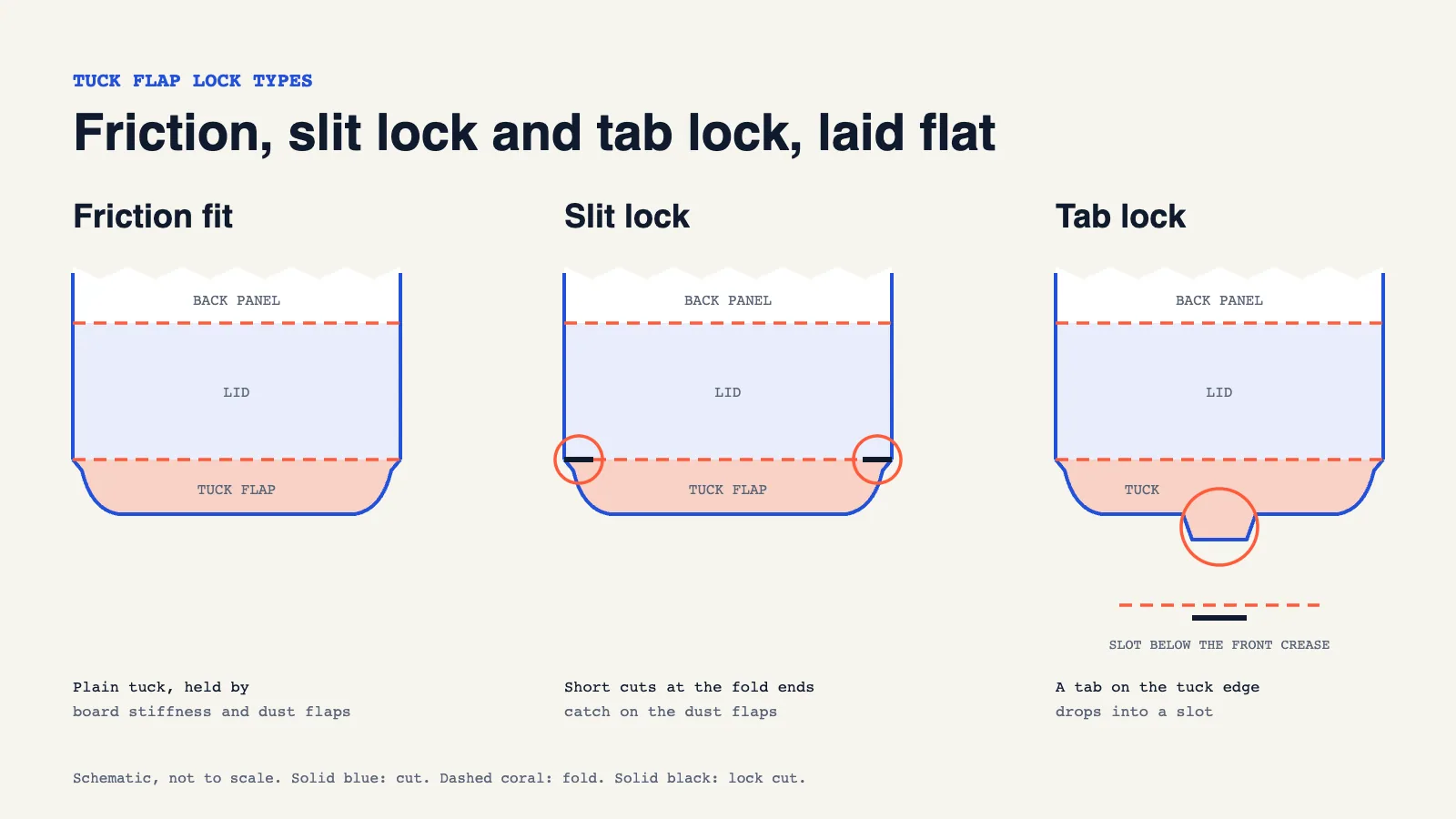
A tuck flap stays shut in one of three ways. A friction fit relies on the board pressing against the inside of the box. A slit lock adds two short cuts at the ends of the tuck fold that catch on the dust flaps. A tab lock adds a small tab on the tuck edge that drops into a slot.
What is a tuck flap lock?
Every tuck end closes the same way: the dust flaps fold in, the lid folds over, and the tuck flap on the end of the lid slides down inside the box. The "lock" is whatever stops that tuck flap from sliding back out when the box is handled, shaken or hung on a peg.
The lock is cut into the same flat blank as the carton, so it is a dieline decision. It applies to any tuck end: the top of a straight tuck end or reverse tuck end carton, and the top of a tuck top auto bottom box.
Patent filings describe the same family of closures. A 1992 US patent on paperboard containers lists the "conventional tuck closures" as "single tuck flap closures, closures using both a tuck flap and tongue lock, and edge lock closures which use a lock tab and associated lock slit." Those map closely onto the three names used by box suppliers today: friction fit, slit lock and tab lock.
How does a friction fit tuck work?
A friction fit is the plain version. The tuck flap has a curved edge and two tapered shoulders, and nothing else. Once it is inside the box, it stays there because the stiff board springs against the inner face of the front panel and the dust flaps underneath push back.
Where it works well:
- light products that fill most of the carton, such as a lipstick, a serum bottle or a tea pouch;
- boxes opened once or a few times;
- retail cartons that sit upright on a shelf.
Where it struggles: as a rule of thumb, the looser the product and the more often the lid is opened, the sooner a plain tuck starts to lift, because every opening softens the fold a little.
How does a slit lock work?
A slit lock keeps the same tuck flap but changes the fold where it meets the lid. Instead of a crease all the way across, the two ends of that fold are cut through for a short distance. When the tuck goes in, the cut ends of the lid edge hook behind the dust flaps, so pulling the lid straight up meets resistance.
One supplier's option sheet describes it as a "tuck top design" with "small slits on either side of the fold to lock the top in place." A 1980 UK patent for a reclosable carton describes the same mechanism in more detail: the tuck flap's hinge score line "may have locking slits cut in opposite ends thereof," and the dust flaps are notched to form shoulders that work with those slits "when the panel is closed and the tuck flap is inserted."
What that means for a buyer:
- No extra part. The slits are cut by the same die that cuts the carton.
- It suits repeat opening. The hook does most of the holding, so a softened fold matters less.
The trade-off is that the dust flap shape and the slit position have to match. If the slits sit too far in, the lid is hard to open; too short, and the hook does nothing.
How does a tab lock work?
A tab lock moves the lock to the middle of the tuck edge. The tuck flap gets a small tab, and the front panel gets a matching slot cut just below its top crease. When the lid closes, the tab drops through the slot and the lid cannot lift until the tab is pulled back out.
The 1992 patent calls this family "tongue lock" and "edge lock" closures, and the Wikipedia article on folding cartons shows a photo of a partially open carton with a "tuck flap and locking tab (tongue)." Names vary by supplier, but the mechanism is the same: a tab and a slot.
Where a tab lock helps:
- heavier products for their size, where a plain tuck would be pushed open from inside;
- boxes that hang on a peg or travel loose in a bag;
- packs with small parts that should not fall out if the box is knocked over.
The trade-offs: the slot is a cut through the front panel, so it shows on the printed face and has to be planned into the artwork, and a tab that is too tight can tear when a customer opens the box in a hurry.
Which tuck flap lock should you choose?
| Lock | How it holds | Best for | Watch for |
|---|---|---|---|
| Friction fit | Board stiffness and dust flaps | Light, snug products opened once or twice | Lid lifting with loose or heavy contents |
| Slit lock | Short cuts at the ends of the tuck fold hook behind the dust flaps | Most retail tuck ends; repeat opening | Slit length matched to the dust flap shape |
| Tab lock | A tab on the tuck edge drops into a slot in the front panel | Heavier products, peg hanging, small parts | A visible slot in the artwork; tab tearing |
A practical way to decide: start with a slit lock, move to a tab lock if the product is heavy for the box or the box will hang, and use a plain friction fit only when the product fits snugly and the box is rarely reopened. Board thickness matters too; a stiffer board holds any tuck better. Our board thickness guide covers that choice.
For playing card boxes and other cartons opened every day, print the dieline at full size on card stock and open and close it a dozen times before you decide.
Does the lock type change the artwork?
Mostly no. Friction fit and slit lock tucks sit inside the closed box, so artwork on them is rarely seen. A tab lock is different: the slot is a cut in the front panel, so keep logos, text and barcodes clear of it.
Our artwork setup guide explains bleed and safe areas, how to read a tuck box dieline covers the cut and crease marks, and dust flaps on tuck boxes explains the flaps that slit locks hook behind.
How do you get the right lock on your box?
For planning, the tuck box dieline generator draws tuck styles at your size so you can test the fold on paper. It uses generic flap shapes, so treat it as a planning drawing.
For production, tell us what goes in the box, how heavy it is and whether it hangs or is opened often. Every order comes with a free digital design and dieline drawn for your size and board, and a digital proof before anything prints. There is no minimum order quantity. Start with the quote form.
FAQ
What is the difference between a friction lock and a slit lock?
A friction lock is a plain tuck flap held in by the stiffness of the board. A slit lock adds two short cuts at the ends of the fold between the lid and the tuck flap, so the lid edge hooks behind the dust flaps when it closes.
Is a slit lock or a tab lock stronger?
A tab lock usually holds a lid more firmly, because the tab has to be pulled back out of its slot before the lid can lift. A slit lock is a lighter hold that still clicks shut and is easier to open again.
Does a slit lock cost more than a plain tuck?
The slits are cut by the same die that cuts the carton, so there is no extra part. Ask for it when you request your dieline and it is drawn in.
Can a tuck box use a lock on both ends?
Yes. A straight or reverse tuck end carton has a tuck at each end, and each one can be a friction fit, slit lock or tab lock. A tuck top auto bottom box has a lock only at the top, because its glued base locks itself.
Sources
- Google Patents, US5366141A "Recloseable paperboard container with optional closure means" (list of conventional tuck closures: single tuck flap, tuck flap and tongue lock, edge lock with lock tab and lock slit), read 3 Nov 2026: https://patents.google.com/patent/US5366141A/en
- Google Patents, GB2073707A "Carton with reclosable end structure" (locking slits at the ends of the tuck flap hinge score line; notched dust flaps forming shoulders), read 3 Nov 2026: https://patents.google.com/patent/GB2073707A/en
- Wikipedia, "Folding carton" (photo of a partially open carton showing tuck flap and locking tab), read 3 Nov 2026: https://en.wikipedia.org/wiki/Folding_carton
- PakFactory, "Slit Lock Tuck Flap" style detail (OP062; "small slits on either side of the fold to lock the top in place"), read 3 Nov 2026: https://pakfactory.com/style-detail-slit-lock-tuck-flap.html