Blog · · Tuckmade team
Hang tab holes: euro slot, sombrero and round hole compared
Euro slot, sombrero, round or triangular hang hole? How each hole shape on a hang tab tuck box meets a peg hook, and how to choose the right one.
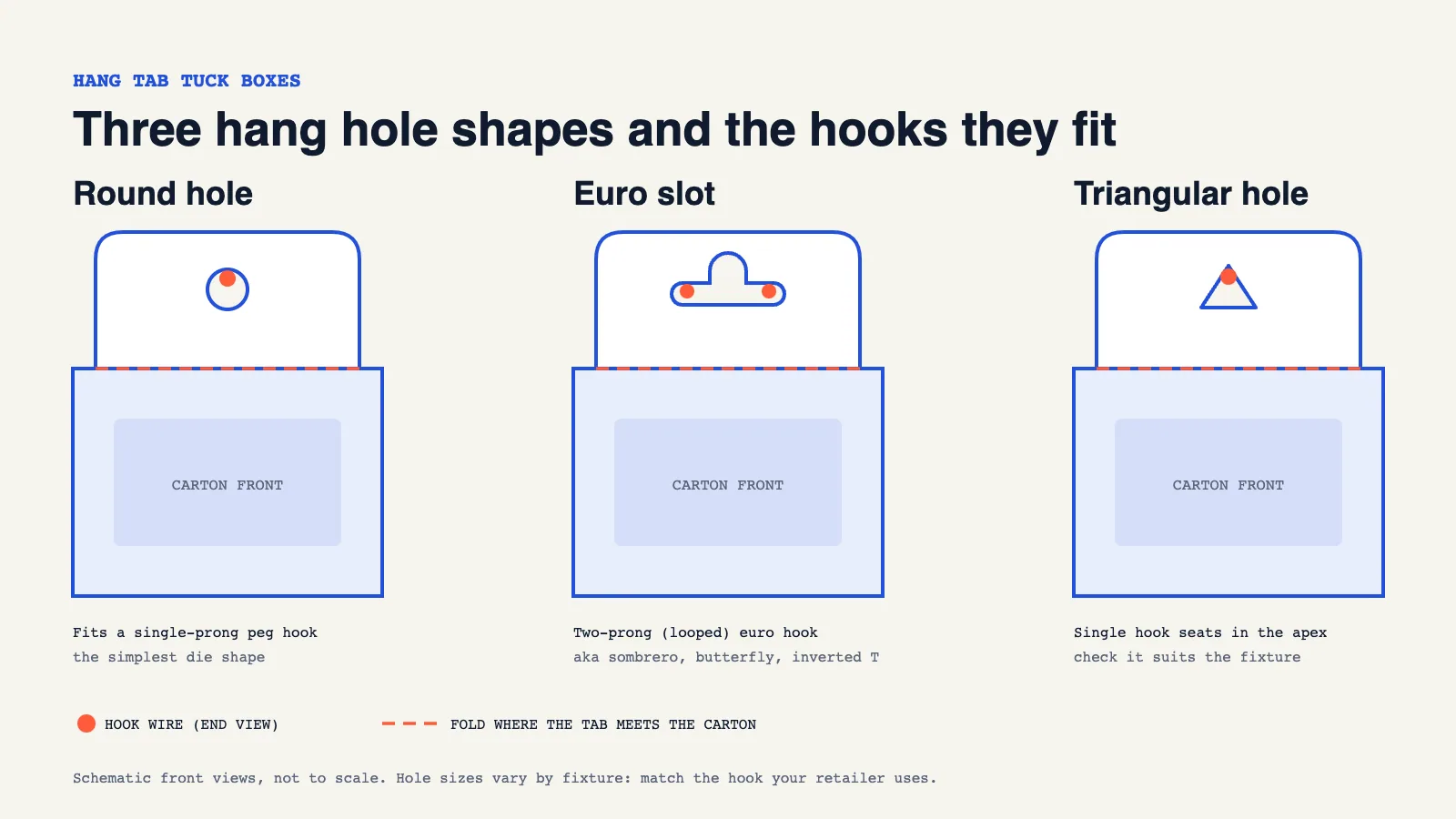
There are three common hang tab hole types: the round hole, the euro slot and the triangular hole. "Sombrero", "butterfly" and "inverted T" are other names for the euro slot, not separate shapes. The euro slot fits two-prong euro hooks; a round or triangular hole fits a single peg hook. Match the hole to the fixture the store uses.
What is a hang tab hole?
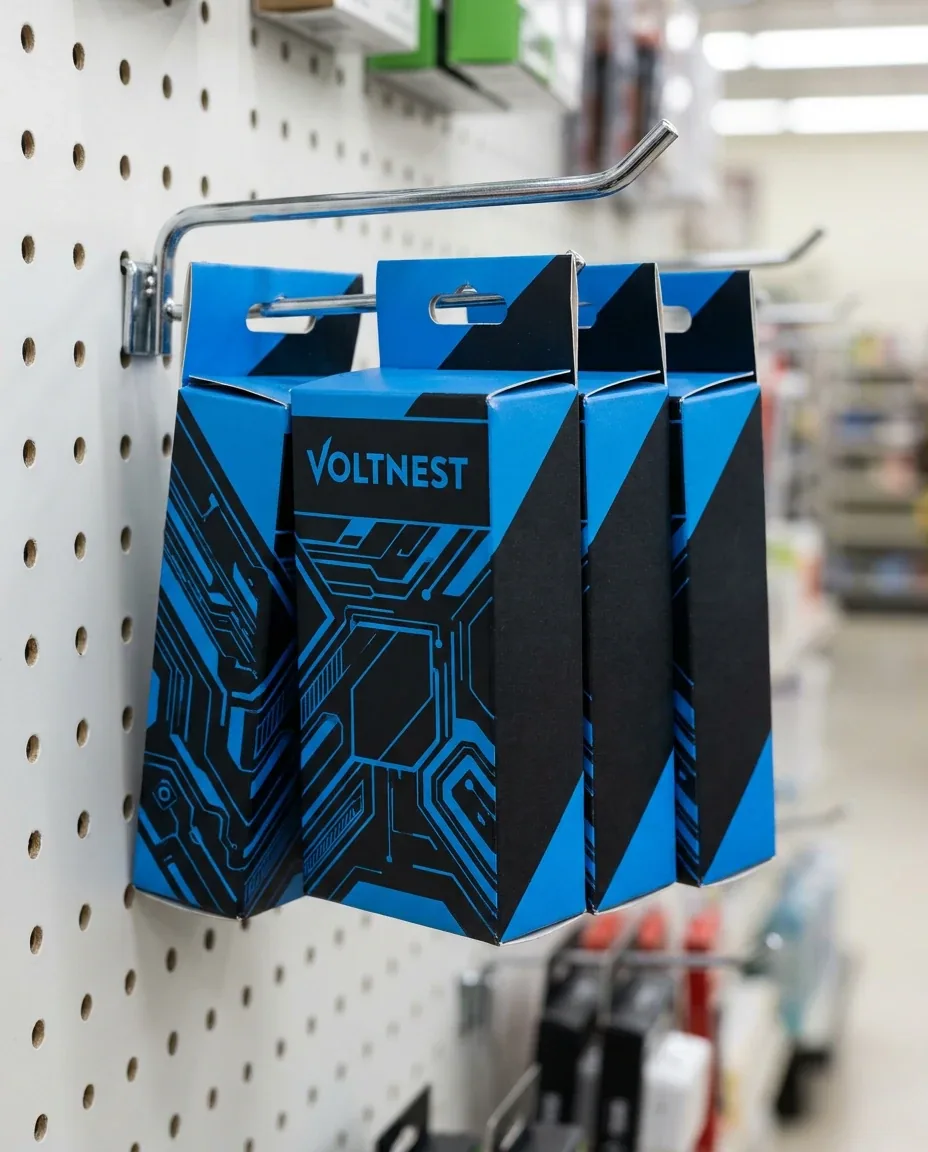
A hang tab is a header panel that extends above a carton so the box can hang on a peg hook as well as stand on a shelf. On a hang tab tuck box, the back panel runs up past the top of the carton and the hole is die cut through that extension in the same pass as the rest of the blank.
Wikipedia's article on perforated hardboard notes that pegboard "is commonly used in retail settings along with steel rods sticking out to hold peggable products such as bagged potato chips, printer ink, and action figures." Those steel rods are the peg hooks your hole has to fit.
What are the main hang hole shapes?
| Hole shape | Also called | Hook it fits | Notes |
|---|---|---|---|
| Euro slot | Sombrero, butterfly, inverted T | Two-prong (looped) euro hook; usually a single hook too | Wide slot with a raised center |
| Round hole | Punch hole | Single-prong peg hook | Simplest die shape |
| Triangular hole | Delta hole | Single-prong peg hook | The wire sits in the top corner |
The naming trips many buyers up. A European patent application on peg hook security devices describes the hang hole on its articles as "a Euro slot (which may also be referred to as an inverted T, a sombrero or a butterfly hang hole)". A US patent application for a retail security tag lists the same family of shapes for its own hang aperture: circular, "substantially triangular" or "the shape of a Euro slot". So if a retailer's spec asks for a sombrero hole, it is asking for a euro slot.
How does a euro slot work?
The same European application describes the shape: the euro slot "comprises an elongate lower region and an upper projection centrally disposed along a length of the lower region." In plain words, it is a wide horizontal slot with a bump in the middle of its top edge, which is where the hat-like "sombrero" name comes from.
It is cut for a two-prong hook. The application describes a "double pronged peg hook or Euro peg hook" whose two prongs are joined at their ends, and says "each of the prongs ... extends through a respective end portion of the lower region of the hang hole." As a rule of thumb, two prongs share the weight and keep the box from swinging, and a single wire hook can usually pass through the slot and rest in the raised center. Check that on the actual fixture.
A European patent for a hanging folding box notes that "the standardized Euro hole has the advantage that it fits the widely used also standardized hook devices." That is why it is a sensible default when you do not know the store's fixture.
When does a round hole make sense?
A round hole is the simplest hole to cut and suits a single-prong peg hook, the kind that sticks straight out of pegboard or slatwall. It fits well when:
- you know the retailer's fixtures are single hooks;
- the carton is light, such as a gift card box or a small accessory;
- the box hangs on your own display or a market stand, where you choose the hooks.
As a rule of thumb, a box on one wire turns more easily than one on two prongs. That matters little for a small card carton and more for a wide or top-heavy box.
When is a triangular hole used?
A triangular (delta) hole also hangs on a single hook. The wire seats in the top corner of the triangle, so the box settles in the same place each time it is hung. Check it against the retailer's hook before you choose it.
Where should the hole go on the hang tab?
Two placement rules come straight from how hanging works. The security device application says the hang hole "is disposed proximate an upper edge of the article such that the majority of the article is disposed below the peg hook," and that it "is typically centrally located across a width of the article so that the article hangs substantially vertically."
For a tuck box that means:
- Center the hole across the width of the carton, so the box hangs straight and the front panel faces the shopper.
- Keep the hole near the top of the header, leaving enough board above it that the hook does not tear through.
- Keep artwork clear of the hole. Treat the hole like a cut line: no text or logos within the safe area around it, as in our bleed and safe area guide.
- Leave room for the swing tag. Many hooks carry a price label: the application describes a swing tag on the hook end that is "typically used to display product information including a price."
Can the hang tab fold away?
Yes, some designs do. The hanging folding box patent describes a suspension tab with a euro hole that can be pushed down into a recessed position, so the same carton can stand on a shelf without the tab sticking up, then be pulled out to hang. A fold-down tab adds die complexity; a fixed header is the common choice, and it is what our hang tab dieline generator draws.
How do you choose the right hole for your tuck box?
- Ask the retailer which hooks are on the planogram: two-prong euro hooks or single pegs. Their spec wins over any rule of thumb.
- No spec? Choose the euro slot: it hangs on both hook types.
- Weigh the packed product. Heavier items, such as hardware or electronics accessories, put more load on the header. A sturdier board such as SBS C1S at a heavier caliper helps; ask about it in your quote.
- Print the dieline at full size, cut the hole and hang a mock carton on a real hook before you approve the proof.
Every order comes with a free digital design and dieline drawn for your size, with the hang hole placed for you, and a digital proof before anything prints. There is no minimum order quantity: order 1 piece or 10,000. Tell us the hook type on the quote form.
FAQ
Is a sombrero hole the same as a euro slot?
Yes. Patent filings use the names interchangeably: a euro slot "may also be referred to as an inverted T, a sombrero or a butterfly hang hole." If a buyer asks for any of these, they mean the same wide slot with a raised center.
Can a euro slot hang on a single peg hook?
Usually, yes: the wire rests in the raised center, while the two ends of the slot are meant for the prongs of a euro hook. Hang a sample on the store's hook to confirm.
Which hang hole is best for heavy products?
As a rule of thumb, a euro slot on a two-prong hook, because the load sits on two points. Pair it with a heavier board and test a sample on a real hook first.
Does the hang hole change the price of a tuck box?
The hole is usually cut by the same die as the rest of the blank, so the shape itself rarely adds a step. A taller header uses more board, and any change to the listed specification is priced in your custom quote.
Sources
- European Patent Office application EP3704996A1, "Security device" (Google Patents), read 5 Nov 2026: https://patents.google.com/patent/EP3704996A1/en
- US patent application US20220406156A1, "Security tag" (Google Patents), read 5 Nov 2026: https://patents.google.com/patent/US20220406156A1/en
- European patent EP2455293B1, "Suspendible square-shaped folding box" (Google Patents), read 5 Nov 2026: https://patents.google.com/patent/EP2455293B1/en
- Wikipedia, "Perforated hardboard", read 5 Nov 2026: https://en.wikipedia.org/wiki/Pegboard